Project:
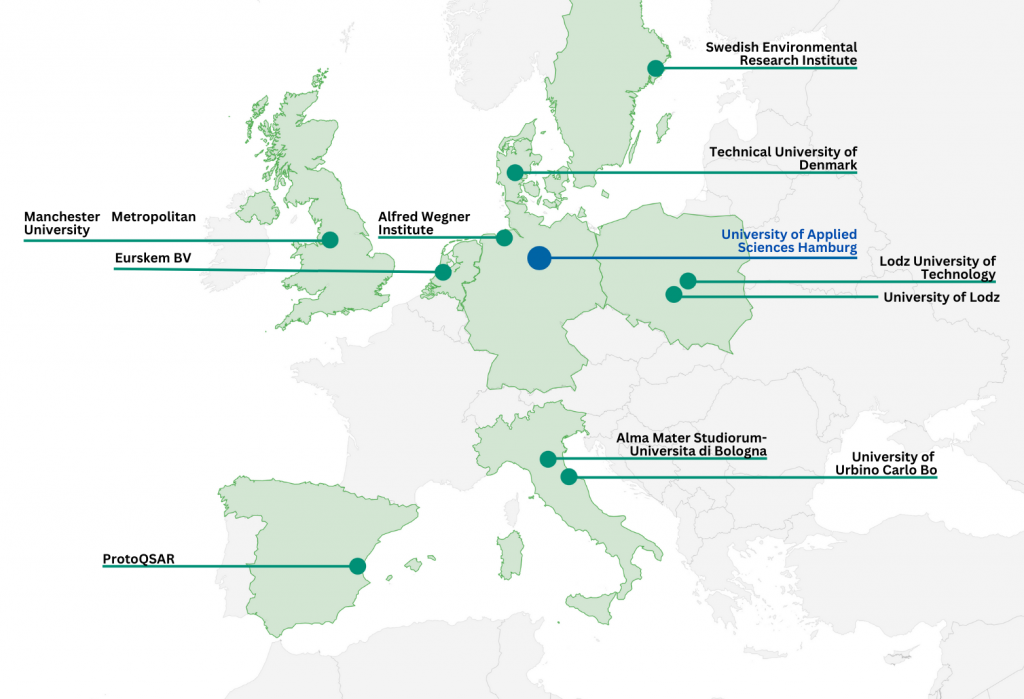
CheMatSustain (#CheMatSustain) is a research initiative, funded by the Horizon Europe Programme of the European Union. Spanning for a 48-month period, our consortium comprises 10 scientific partners from 7 EU countries, alongside collaboration with 1 esteemed UK Associate Partner and lead by the Hamburg University of Applied Sciences.
| Duration: | Budget: | Funding Source: |
| January 1, 2024, to December 31, 2027 | €4,924,128.50 | European Commission |
Our Project Vision:
At CheMatSustain, we recognize the transformative potential of nanotechnology and the significance of Safe and Sustainable by Design (SSbD) strategies in ensuring the safety and sustainability of nanomaterials and nanotechnology. Thus, the project envisions a future where innovative methods for safety and sustainability assessments of chemicals and materials, especially at the nano level, play a pivotal role in achieving a climate-neutral, circular economy continent. Through collaboration, research, and innovation, we strive to pave the way for a brighter, greener future for generations to come.
Project Methodology:
In pursuit of our project’s overarching goal, our methodology consists of eight steps, each intricately linked with the Work Packages (WPs) that constitute the project’s framework.
The first step involves the identification and selection of four sets of chemicals, representing advanced groups of CNMs. These selected CNMs will undergo rigorous testing to assess their chemical and physical attributes, with the aim of enhancing their safety and sustainability.
The second step focuses on conducting appropriate pilot experiments and developing more realistic in vitro models. These tasks are crucial for addressing current gaps in the field of CNMs hazard assessment.
The third step entails the high-resolution analysis of the selected CNMs, employing advanced techniques such as photoelectron spectroscopy and molecular biology methods (transcriptomics and proteomics). This will provide a comprehensive understanding of the CNMs’ properties and behaviour.
Subsequently, the fourth step involves the delivery of reliable data supported by computational modelling. This data-driven approach enables the development of grouping and Read-Across methods.
In the fifth step, we focus on evaluating the safety and sustainability of the selected CNMs by developing Safe & Sustainable by Design (SSbD) criteria including a holistic approach to assessing their entire life cycle.
The sixth step develops harmonized standardized test methods suitable for regulatory contexts. These methods play a pivotal role in supporting the implementation of the proposed SSbD framework.
Moving forward, the seventh step aims to enhance efficiency and effectiveness in CNMs development. By reducing costs and time associated with product design, time-to-market, and regulatory compliance, we aim to streamline the process of bringing safe and sustainable CNMs to market.
Lastly, our eighth step focuses on fostering the uptake of the new methods among academia, public authorities, and the private sector, disseminating our innovative methodologies and driving positive change.
Scope of CheMatSustain Activities:
The primary aim of the CheMatSustain project is to enhance and standardize screening and testing methods, protocols, and assessments for chemicals and (nano)materials within the European Union. Our objective is to create a set of tools that are robust, reliable, and efficient, including high-throughput and in-silico models. By doing so, we aim to improve the safety and sustainability of these substances, ensuring a more streamlined and effective approach to hazard, risk, and sustainability evaluations.
We divide our work into a set of work packages as indicated below:
- WP1 Project coordination, management, administration
- WP2 Chemical and (nano)Materials selection, preparation and physicochemical characterisation
- WP3 Pilot tests for metabolic response following exposure to selected CNMs
- WP4 Pilot Tests of CNMs identification with photoelectron spectroscopy
- WP5 Chemoinformatic prediction models
- WP6 Safety and Sustainability assessment
- WP7 Validation of approaches in light of EU strategy and policy
- WP8 Upscaling, replication, communication and dissemination
Project website: https://chematsustain.eu/about/