Interpreting colours is a nightmare
Where some see the emerald shine of an orchid and the deep purple of an eggplant, others see only violet – why can the same colour be interpreted differently? Can a drug test fool us if we misinterpret the colour? How do we develop a sensor that works reliably – regardless of who is reading the results?
Dr hab. Łukasz Półtorak, Associate Professor at the University of Lodz, a chemist from the Faculty of Chemistry of the University of Lodz, who as part of the Chemistry in Focus series gave a lecture on the limits of reliability of colorimetric tests and modern methods of detecting psychoactive substances, answers these and many other questions.
Precise detection of narcotic substances
In a characteristic, accessible and engaging way, Prof. Półtorak presents achievements in the development of electrochemical sensors for detecting narcotics – from laboratory concepts to practical applications in the analysis of street and biological samples. The focus is on cocaine, heroin, caffeine and paracetamol – substances whose presence (or absence) should be confirmed not by colour interpretation, but by hard data.
We encourage you to watch the video and immerse yourself in the fascinating world of chemistry!
The lecture was organised by the International HUB as part of the Chemistry in Focus event.
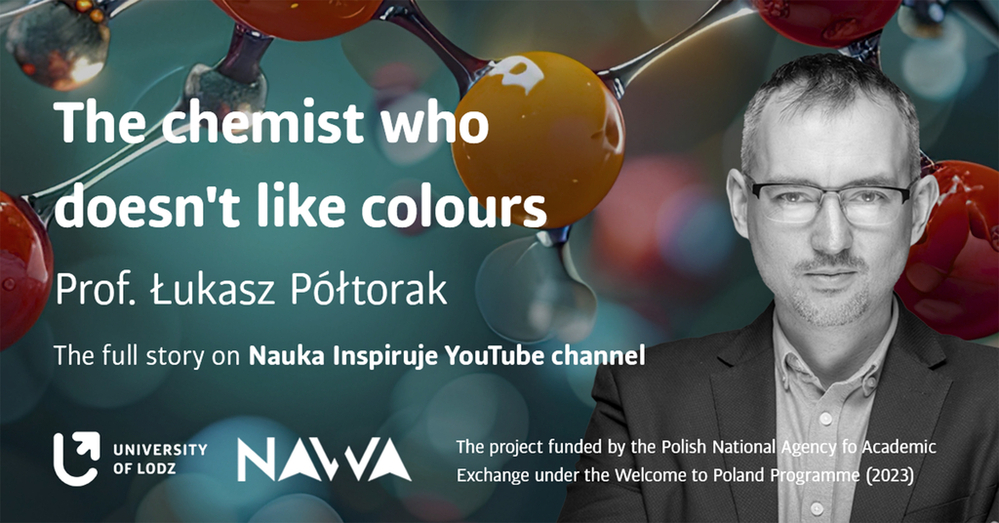
Edit: Michał Gruda and Małgorzata Jasińska (Centre for External Relations and Social Responsibility of the University, University of Lodz)
The title graphic: Michał Strzelec (Centre for Brand Communications)
Photo: Dr Bartosz Kałużny (Centre for External Relations and Social Responsibility of the University)